2. Network Architecture
Amazon Sidewalk is a wireless network providing low power and low cost IoT connectivity both around and beyond the home. Amazon Sidewalk accomplishes this via Amazon Sidewalk Gateways and Endpoints. Amazon Sidewalk Gateways route traffic from Endpoints to the Internet. Amazon Sidewalk supports different data rates from 2 kbps on SubG-CSS, 50 kbps on SubG-FSK, to 1 Mbps on BLE. Each Gateway may handle multiple Amazon Sidewalk-enabled IoT Endpoints like security sensors, trackers and motion sensors. In addition to the SubG-FSK and SubG-CSS radios, the Amazon Sidewalk network and architecture also encompass Bluetooth technologies.
Amazon Sidewalk Endpoints operate under two distinct radio-agnostic modes or configurations: Wide Area Network (WAN) and Personal Area Network (PAN). In the Wide Area Network configuration, also known as roaming, there is no association made between the Gateway and Endpoints. Each Endpoint has its own unique identity, and security credentials used to connect to the Amazon Sidewalk network. In the Personal Area Network configuration, there is an association between the Endpoint and the Gateway belonging to the same user. This allows Amazon Sidewalk to set the appropriate data usage limits and routing prioritization.
Each of these configurations comes with its own security model. A Gateway has to be configured to participate in the Amazon Sidewalk network. The process of configuring a Gateway to participate in the Amazon Sidewalk network is governed by the Amazon Sidewalk consent agreement. The maximum bandwidth of an Amazon Sidewalk Gateway to the Amazon Sidewalk Cloud is 80 kbps. When a registered Gateway user shares their Gateway’s bandwidth with Amazon Sidewalk, the total monthly data used by Amazon Sidewalk is capped at 500 MB per account.
Endpoints working in the Amazon Sidewalk network may use three wireless technologies for communication - see figure 2.1 which shows the corresponding ranges. The short range uses BLE over a 1 or 2 Mbps link. The medium range is based on SubG-FSK. The long range is based on SubG-CSS. Currently, Endpoints may use only one of these wireless technologies. Dynamic switch between these three modulations and consequently data rates are not currently supported on the Endpoint side. Gateways support all three of these technologies.
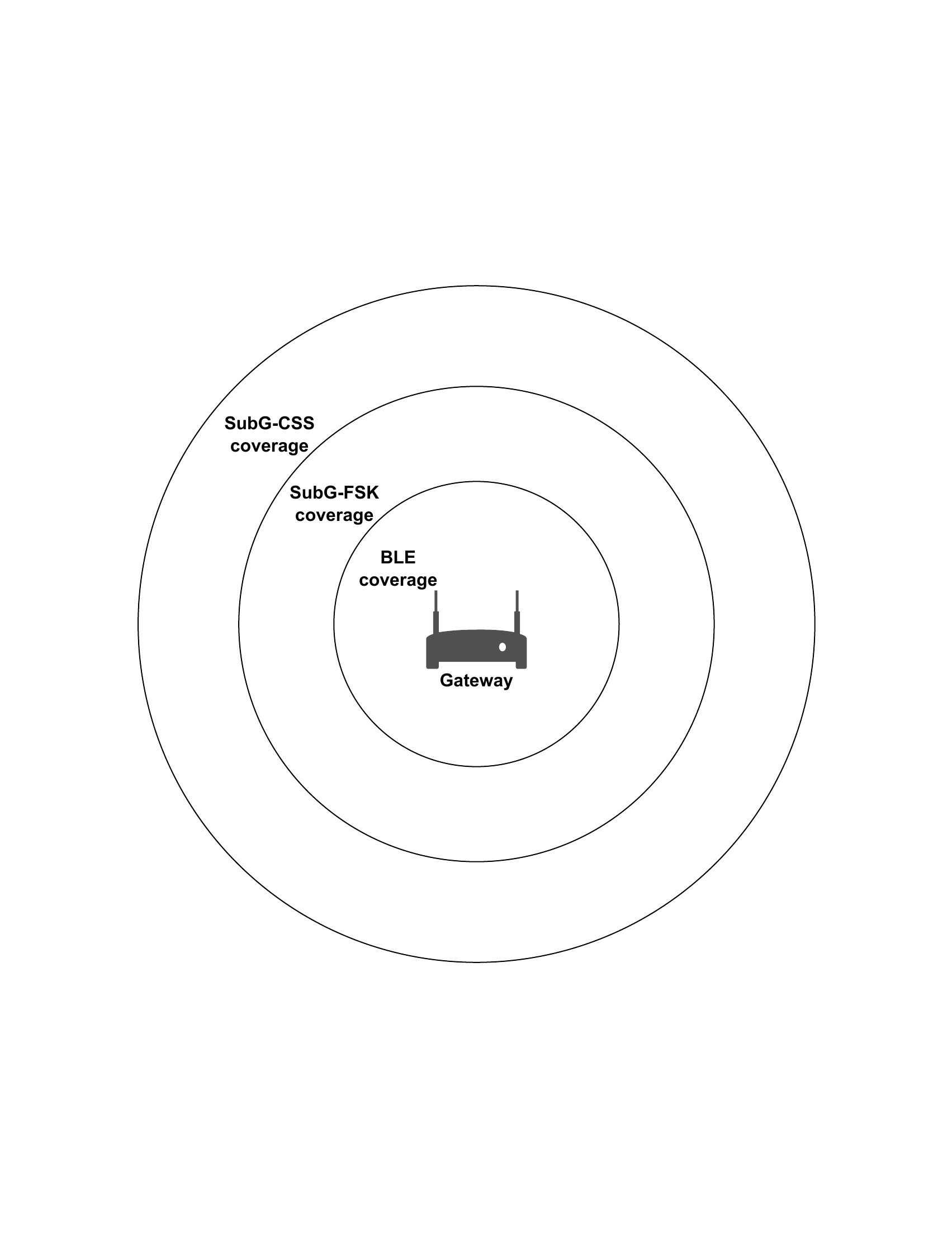
Fig. 2.1 Sidewalk wireless technologies coverage
Endpoints may use one of two connection modes to connect to the network: asynchronous or synchronous.
Connection configuration includes the following options:
-
The following wireless technologies and communication ranges are enabled on Endpoints:
- Short range communication using BLE
- Medium range communication using SubG-FSK
- Long range communication using SubG-CSS
-
Modulation usage has an impact on data rate traffic:
-
There are two connection modes:
-
There are two types of sub-network in which the Endpoint can operate:
Theoretically there are many possible ways to configure Amazon Sidewalk Endpoints, but the specification supports three configurations:
- SubG-FSK - synchronous - WAN
- SubG-CSS - asynchronous - WAN
- BLE
Dynamic switching between configurations at the mac layer is not possible.
The following diagram shows the full Amazon Sidewalk network component end-to-end (E2E) software architecture.
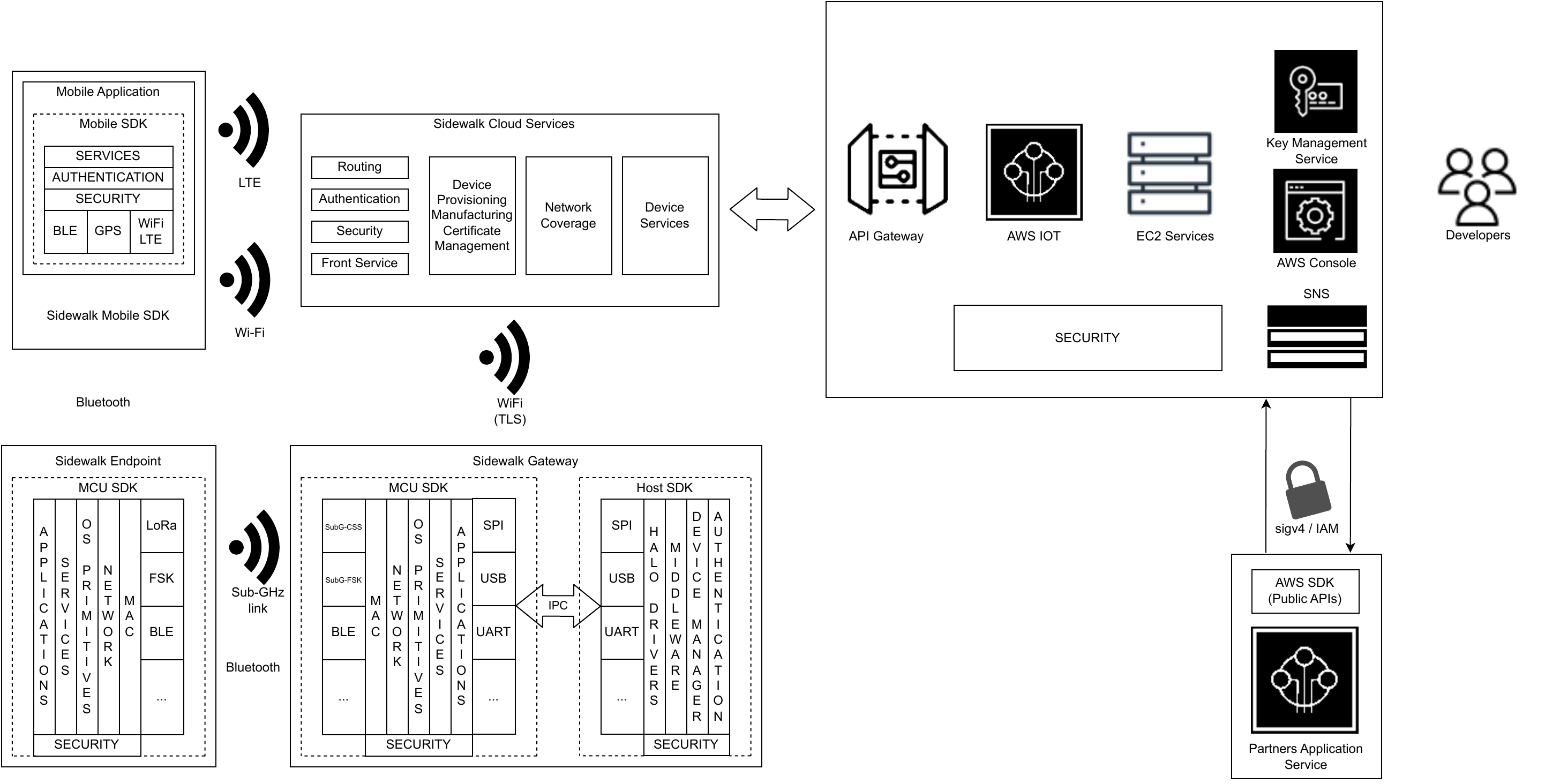
Fig. 2.2 Sidewalk E2E Architecture
2.1 Entities and roles
The main actors in the Amazon Sidewalk network are as follows:
- End user interface, which could be placed in a mobile phone as an application or in a web service.
- The cloud, which is the central entity of the whole system.
- Gateways, which are nodes providing Amazon Sidewalk connectivity to Endpoints like security sensors, trackers and motion sensors.
- An Endpoint, which provides specific functionality to its owner.
All of these elements create the Amazon Sidewalk network. A high level description of each element may be found in subsequent sections.
The specification defines interaction between Endpoints and Gateways. Cooperation between neighbor Gateways is described from a high level point of view to facilitate a better understanding of the whole system. A detailed description of Gateways interaction is outside the scope of this document. The description of interaction between cloud and Endpoint is provided in the Application Layer level from the protocol stack perspective.
2.1.1 End user interface
User interaction with the whole system is provided via the mobile app and/or via the web interface. User changes in the user interface related to selected Endpoints trigger message flow which is described in figure 2.3.
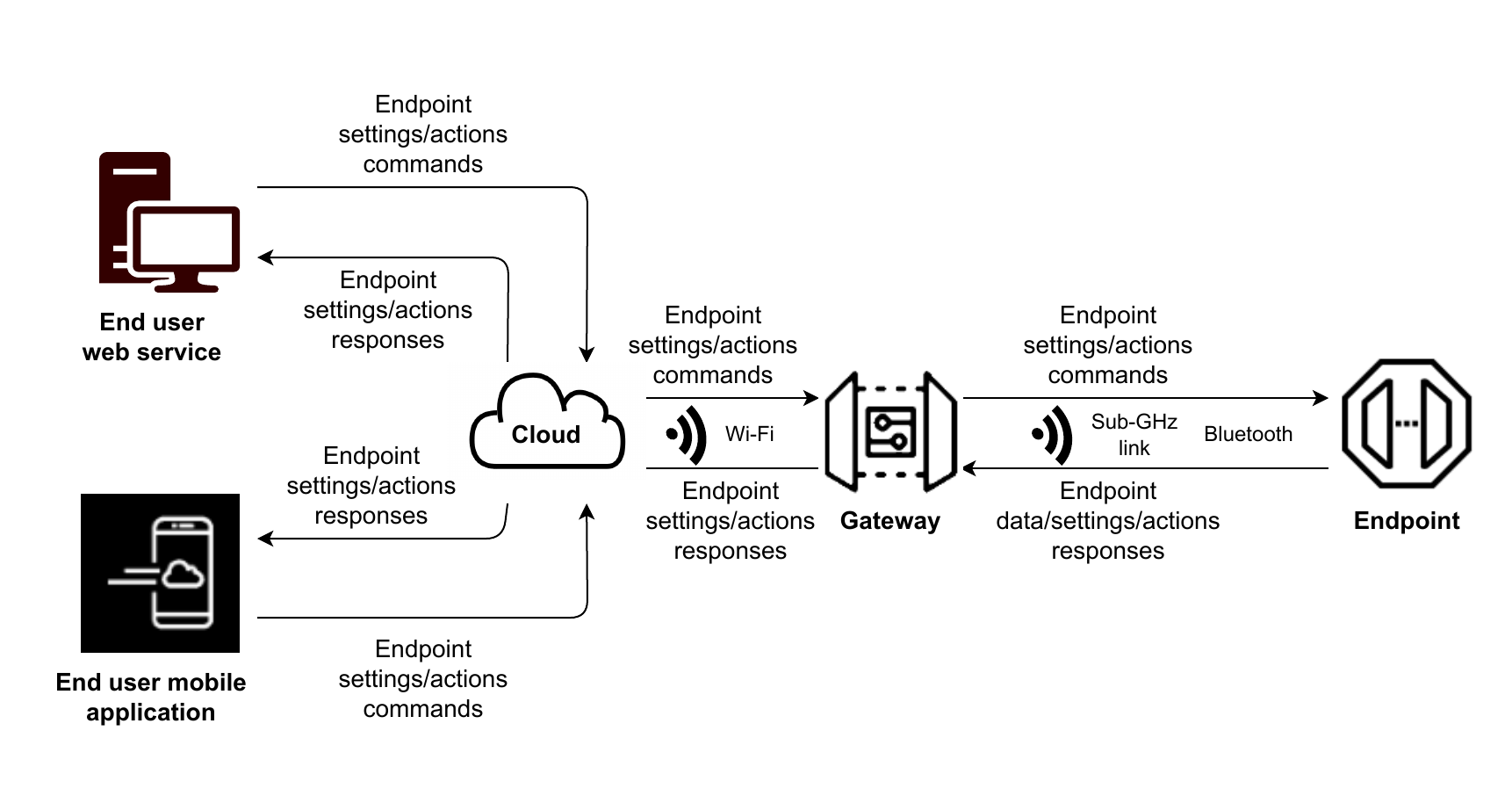
Fig. 2.3 End user interaction with an Endpoint
2.1.2 Cloud
The cloud is the central component of the Amazon Sidewalk network. It hosts the Amazon Sidewalk Network Server responsible for packet routing. The cloud also provides application level services for different types of Endpoints, participates in communication between end user applications and Endpoints, handles different security aspects, and many other functions. The cloud also works as a database, incorporates a central routing repository, and stores different information about Endpoints, like connection profile settings and radio conditions. The cloud also has knowledge about the network topology, coverage and Gateways supporting roaming.
The cloud schedules downlink messages to Endpoints using the best available route. In synchronous mode, the Connection Profile determines the downlink transmit schedule. In asynchronous mode, downlink uses ad hoc scheduling. The cloud is responsible for scheduling downlink transmissions to avoid storing data on the Gateway for long periods. The Amazon Sidewalk Cloud selects the best Gateway, based on RSSI and other heuristics, to route downlink traffic, especially in cases when Endpoints are roaming.
2.1.3 Gateways
Amazon Sidewalk Gateways are special nodes of the Amazon Sidewalk network. These Nodes provide access to the external network for Endpoints organized in PAN and WAN networks. A single Gateway may support one PAN and one WAN network (for more detailed information about network types and topology, see section 2.2 and section 2.3). The traffic from an Endpoint to the cloud is handled by the Gateway as a passthrough node. The Gateway has no access to the application data sent from an Endpoint or received from the cloud because the application data are encrypted at the network and application levels.
Gateways may work in different configurations mainly impacting used modulations and subsequently different data rates. SubG-CSS and SubG-FSK modes of operation use the same radio, dynamically switching between the modes at runtime. SubG-CSS allows asynchronous while SubG-FSK allows synchronous communication. SubG-FSK-only or SubG-CSS-only modes of operation are also possible. All of these possible configurations are described in section 5.4.
BLE uses a separate radio so works independently of SubG-CSS or SubG-FSK usage. A Gateway may receive data from SubG-CSS or SubG-FSK and BLE links simultaneously. The downlink transmission to an Endpoint is done either by SubG-CSS, SubG-FSK or BLE link based on the cloud’s decision.
A Gateway having SubG-CSS or SubG-FSK capability has its own limited database which stores information about TX opportunities for operating Endpoints. Dependent on the user configuration, roaming support may be enabled or disabled. Based on stored information, a Gateway is able to recognize roaming Endpoints and subsequently allow or reject traffic coming from Endpoints. A Gateway also stores Endpoint network measurements reports so it may control Endpoints’ power transmission.
As well as functioning as network service providers, Gateways also aid network topology map construction and maintenance in the cloud. Gateways perform periodic scans of their neighboring nodes and relay this information to cloud.
Occasionally a Gateway may lose its connection to the cloud. This information is provided to all surrounding Endpoints in the Beacon frame (see section 5.1.3.1). When a Gateway link to a cloud is malfunctioning then it may try to get access to the external network through neighbor Gateways. This mode is called ”distressed mode” and is described in section 5.6.5. Information about the Gateway-cloud link health is not available for SubG-CSS Endpoints.
2.1.4 Endpoints
An Endpoint is a device that does not have responsibility for routing data or maintaining connection with the Amazon Sidewalk network for any device other than itself. These Endpoints provide different types of functionalities for the end user such as tracking devices, motion sensors and many others. These Endpoints have no direct Internet connectivity and are connected to the network through Amazon Sidewalk Gateways.
Endpoints operating using the SubG-FSK mode achieve synchronization during the Gateway discovery and subsequently the Beacon detection process. The procedure is described in section 5.2.1. When a Beacon is received, the Endpoint gets uplink and downlink offset and periodicity. The Endpoint may exchange data as long as it is synchronized. A lack of synchronization results in a new Gateway discovery process.
An Endpoint operating with SubG-CSS may work in asynchronous mode only and WAN network type. The Endpoint does not need to be time-synchronized or associated with a Gateway. The Endpoint starts its transmission when required and does not specify which Gateway may handle that traffic. The uplink (UL) may be detected by various Gateways and the data is sent by them to the cloud. The decision about which Gateway shall handle downlink to the Endpoint is taken by the Amazon Sidewalk Network Server. The process of sending and receiving data between Endpoint and Gateway is described in section 5.3.
Endpoints operating in asynchronous access mode are configured in one of two available Power Profiles. Basically, profiles configure the frequency of RX opportunities. The selected Endpoint profile have a direct impact on power consumption and also latency in both the uplink and downlink directions. Details related to Power Profiles are described in section 5.5.
An Endpoint using BLE preserves behavior specified in the Bluetooth Low Energy Specification v 4.2. Chapter 6 provides the specification for Beacon and data frames. It also provides all other information required for appropriate BLE interaction of the Endpoint with the Amazon Sidewalk system that is complementary to the BLE specification.
2.2 PAN
Personal Area Network (PAN) integrates Endpoints and Gateways which belong to the same registered Amazon or Ring user account and allow them to bypass the opt-out and data limit restriction. All Endpoints within the PAN area share the same security key called a PAN key or broadcast key. This key is provided to an Endpoint at the time of device provisioning.
PAN can have one or more Gateways. These are central nodes of the network and can serve one or multiple Endpoints.Figure 2.4 shows the case when the PAN has one Gateway as a central node and a few Endpoints which are connected to the cloud via the Gateway.
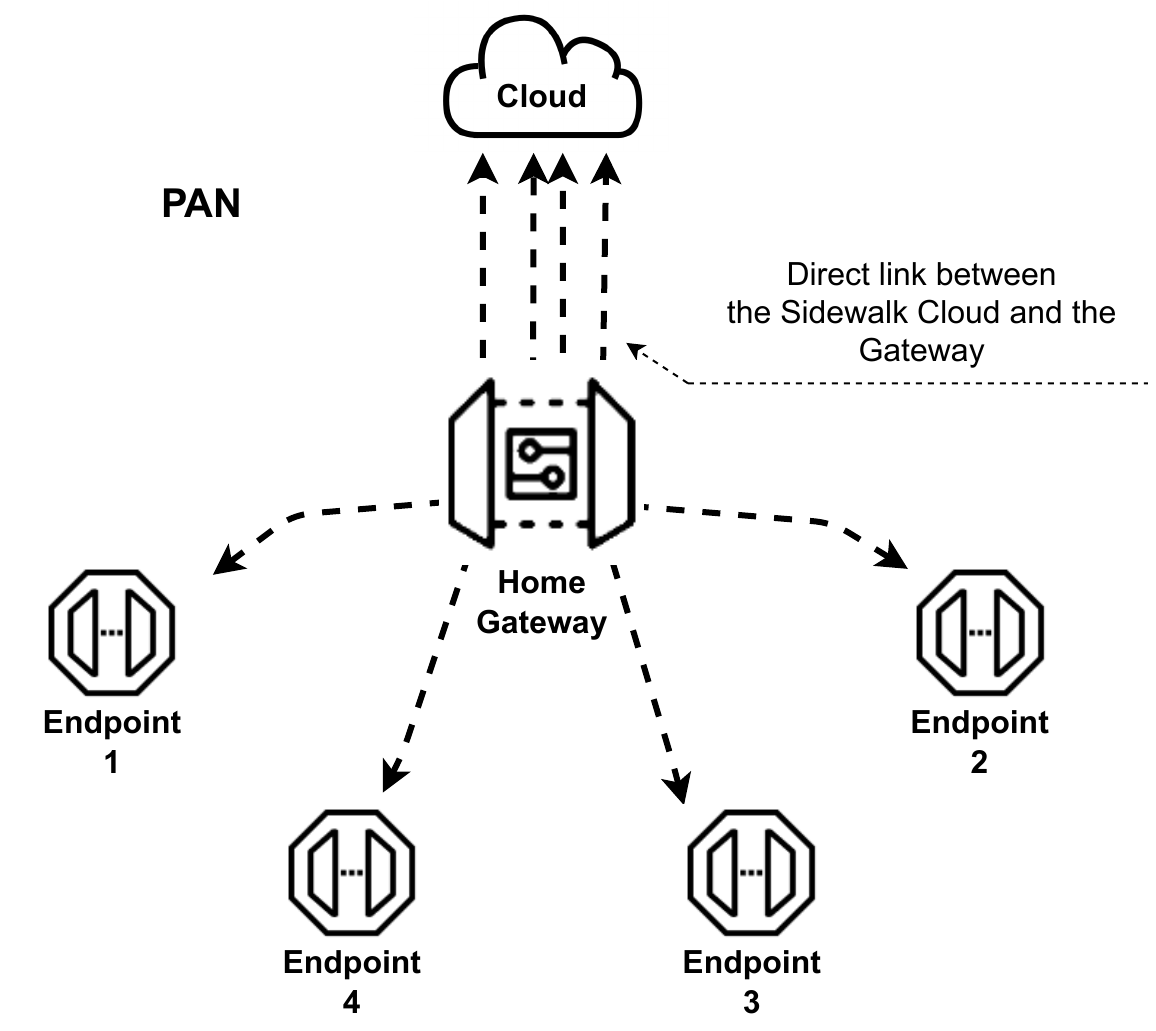
Fig. 2.4 Endpoint—cloud communication
Endpoints on the Amazon Sidewalk network shall limit the number of messages transmitted on the PAN BLE uplink. For the limit see Table 2.1. If an Endpoint exceeds the limit on the number of messages transmitted on the PAN uplink, then it may be disconnected from the Amazon Sidewalk network.
Table 2.1 Maximum throughput for each Endpoint on PAN uplink
| PHY | Maximum throughput/messages |
|---|---|
| BLE | 600/min |
2.3 WAN
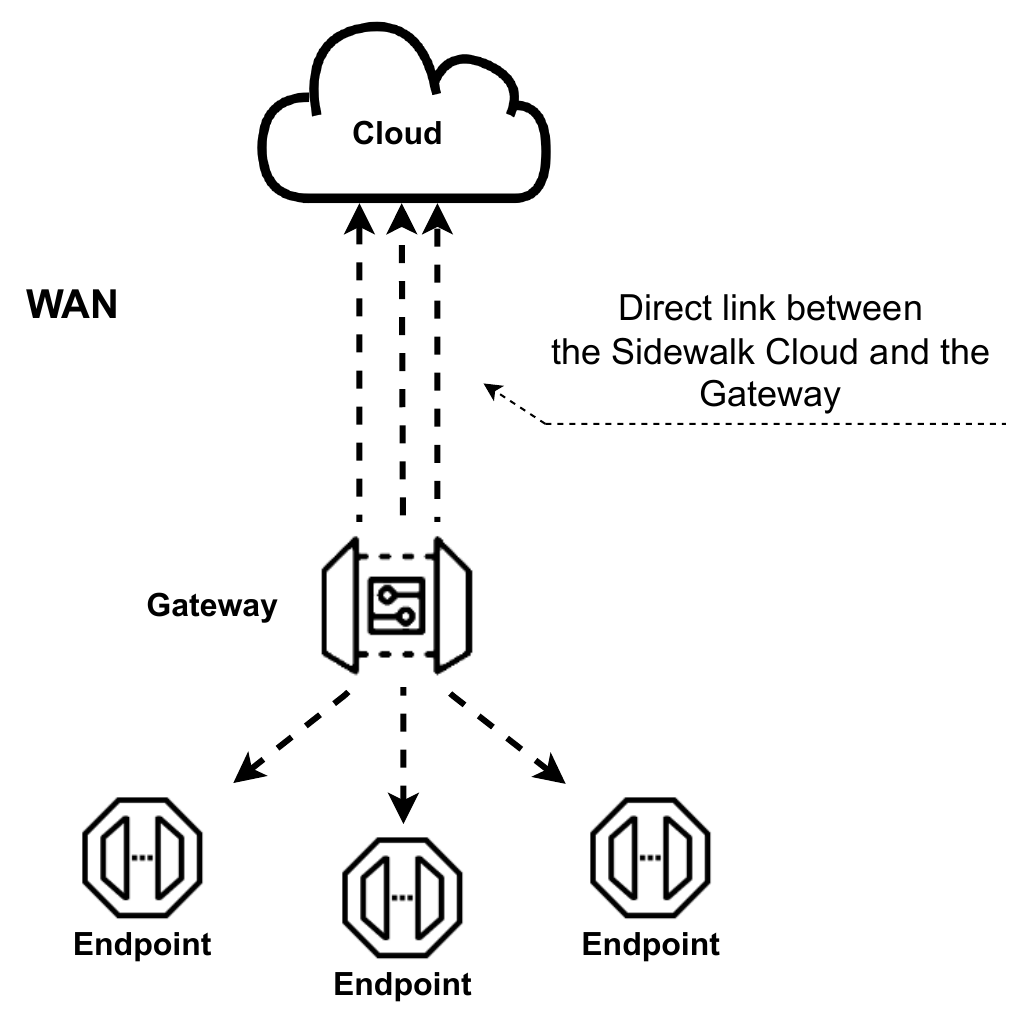
Wide Area Network (WAN) integrates Endpoints and Gateways independent of their ownership. Each Endpoint within the WAN area has its own unique device key which changes periodically. The cloud is the entity which takes responsibility for ensuring authenticity and integrity of the incoming messages from the Endpoints. The security model adopted by WAN Endpoints is called WAN Network Topology.
WAN has multiple Gateways which serve one or multiple Endpoints. Unless roaming support is disabled by the user, all the Gateways are by default configured to serve any Endpoints. In this case, Gateways provide connectivity beyond the limit of the Personal Area Network. The Gateway mostly serves as a passthrough device. Endpoints may use SubG-FSK, SubG-CSS modes and BLE to communicate over the WAN network.
The end user may restrict usage of its own Gateway from supporting other users’ Endpoints in the WAN network topology. Endpoints working in SubG-FSK mode may get the indication whether Gateway supports roaming Endpoints. This information is provided in the Beacon frame format on the Link Layer level. When an Endpoint is in WAN mode outside its own Gateway coverage then should refrain from sending a message to the Gateway when it does not support roaming.
Endpoints working in SubG-CSS mode have no information about which Gateway supports roaming or not. The SubG-CSS Endpoint sends the message and each Gateway receiving that message takes a decision whether the data should be forwarded to the cloud. Due to Amazon Sidewalk network’s spatial diversity, it is possible that two or more Gateways may forward the same message to the cloud. It is the cloud’s task to recognize duplicated packets and also take a decision about which Gateway would handle downlink transmission. Communication in the WAN network is shown in figure 2.5.
The end user may restrict usage of its own Gateway from supporting other users’ Endpoints over all PHYs.
The Amazon Sidewalk network enforces uplink maximum traffic rates for endpoints. Please refer to Sidewalk End Device Maximum Uplink Traffic Rates in the Sidewalk documentation for details.